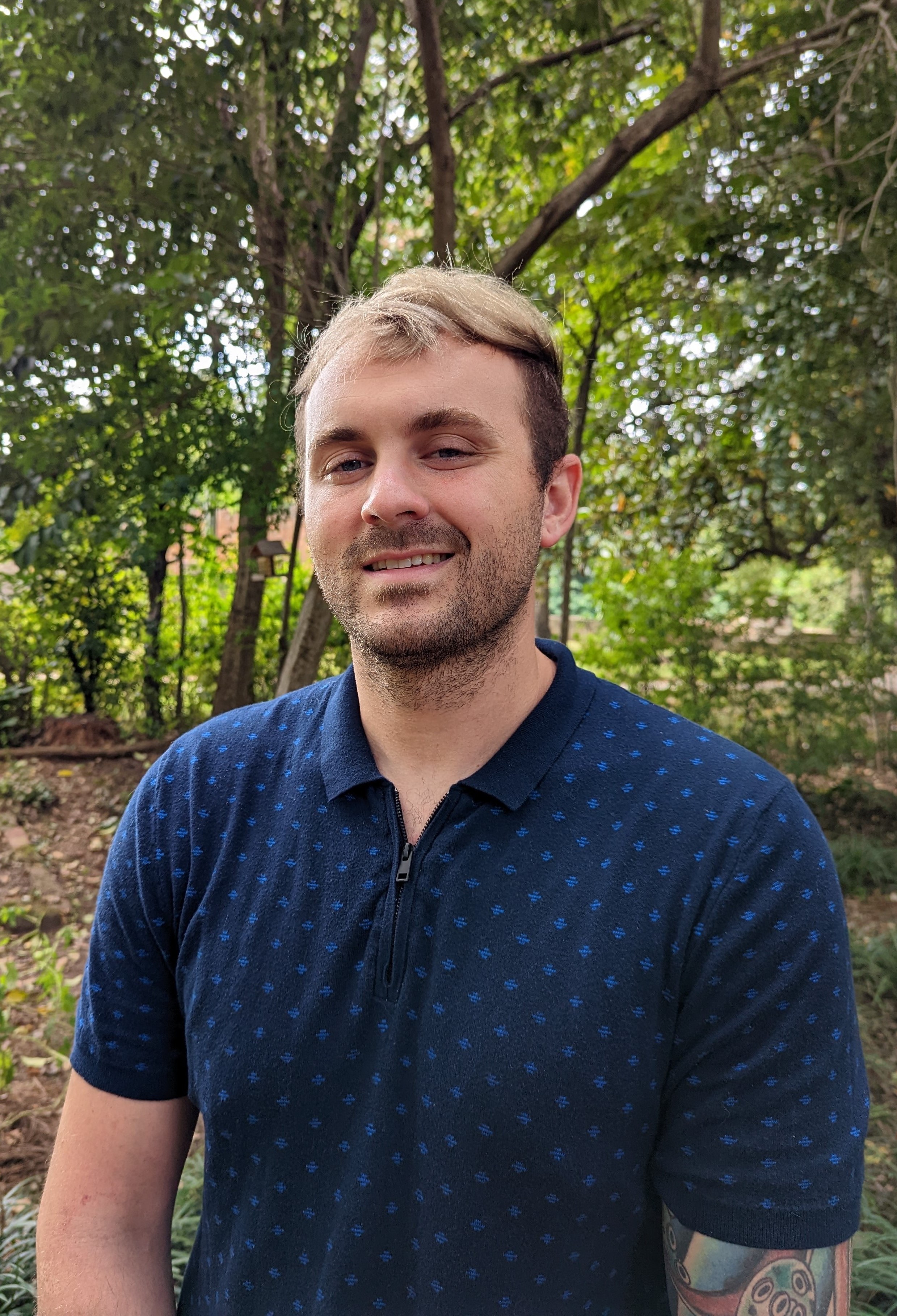
I am an evolutionary genomicist interested in how genome architecture shapes evolutionary responses to novelty. As anthropogenic activities continue, species are forced to face novel conditions offering an opportunity to interrogate the fundamental processes driving rapid evolution. My research leverages these opportunities to ask how the organization of the genome itself influences whether and how populations adapt. To answer this, I generate chromosome-level genome assemblies for non-model organisms and pair them with population genomic, ecological, and phenotypic data to build integrative frameworks that link genome organization to adaptive outcomes. A central goal of my work is connecting across scales — from the molecular mechanisms by which genomic variation produces phenotypic diversity, to how those mechanisms play out across populations and species experiencing rapid environmental change.
I earned my Ph.D. in Biology from the University of Alabama with Ryan Earley, where I worked on the mangrove rivulus (Kryptolebias marmoratus), a small self-fertilizing killifish found across the fragmented mangrove forests of the Caribbean, Central America, the Bahamas, and Florida. This system offers a rare opportunity to study how environmental context shapes genomic and phenotypic variation — its natural capacity for self-fertilization produces isogenic lineages, providing a powerful framework for separating genetic from environmental contributions to phenotypic variation. Using this system, I showed that developmental timing and environmental conditions can restructure gene expression and phenotypic diversity even in the absence of genetic variation1. I also used landscape genomic approaches to understand how the spatial structure of mangrove habitats mediates gene flow and shapes the distribution of genomic variation across populations2,3. I am currently an NSF-funded postdoc at New York University with Kristin Winchell, where I am developing the northern two-lined salamander (Eurycea bislineata) as a model for studying evolutionary responses to urbanization and climate change4. Through this work, I combine morphological, physiological, and whole genome data to evaluate how novel urban environments drive shifts in traits and genomic variation in an environmentally sensitive group. Across these systems — and others including the invasive spotted lanternfly (Lycorma delicatula)5,6 and the Italian wall lizard (Podarcis siculus) — my research is unified by a focus on how genome organization and demographic history interact to shape evolutionary trajectories under environmental novelty. By working across diverse lineages, I aim to uncover whether shared genomic features produce common evolutionary responses to novel environments, and to trace those responses down to the molecular mechanisms that connect genome architecture to phenotypic change.